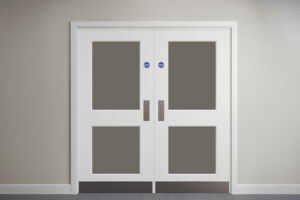
Acoustic fire doors have two jobs. They hold back fire and smoke for their rated time (30 or 60 minutes) and they reduces the noise that passes through the opening, which matters in a building where the door has to meet both requirements.
What Is An Acoustic Fire Door?
An acoustic fire door is a fire door that also has a sound reduction rating. It’s used where noise needs to be reduced or where privacy matters between two spaces. In a block of flats, an entrance door needs to limit the noise coming from the shared corridor. In doctor’s surgeries or hospitals, doors help keep conversations in treatment rooms private. Acoustic doors are also found in hotels, schools and offices where there’s a need for reduced sound travel.
How Is The Sound Reduction Measured?
How well a door reduces sound is measured using the weighted sound reduction index. Rw is the rating a door is given on that index, in decibels (dB). The higher the number, the less sound passes through. A door rated Rw 30 reduces the noise passing through it by roughly 30dB.
As a practical example, the NHS acoustics guidance (HTM 08-01) puts a sealed door at around Rw 30 to 35. The same door without seals drops to around Rw 20 to 25. The guidance sets sound insulation targets for specific rooms rather than a rating for the door itself.
The government has issued guidance on how to meet the sound insulation requirements in the Building Regulations in England, called Approved Document E. The requirements apply to flats, specifically doors in the corridor walls of flats. It asks for a rating of at least 29 dB Rw. A sealed door usually meets that. An unsealed door usually doesn’t.
What Makes A Fire Door Acoustic?
How well a door blocks sound depends on how it’s built. Three things decide its performance
- Mass: a solid, heavy core blocks more sound that a light one
- Seals: sound passes through any gap, so the door must have seals around the entire perimeter, including the threshold. No air gaps should be between the door and the frame.
- Glazing: any vision panel shouldn’t reduce the sound insulation of the doorset
Seals make a significant difference, as the Rw figures above show. A solid-core door with seals and the same door without them can be around 10 dB apart.
How Does This Work With A Fire Door?
A fire door already has intumescent strips, which swell in a fire to fill the gap between the door and the frame. Acoustic seals do a different job. They limit the sound that passes through gaps in everyday use.
A fire door is certified as a complete set, with its frame, seal and fittings. If you choose to add or change parts afterwards, the certification most likely will no longer cover the door. That includes acoustic and threshold seals, so they should be fitted before the door is tested for its FD30 or FD60 rating.
Where Are Acoustic Fire Doors Used?
Flats / Apartments: The entrance door has to be a fire door and has to limit noise from the shared corridor. This is set out in Approved Document E, which also specifies the sound requirement.
Healthcare Facilities: Consulting and treatment rooms may require privacy. The NHS acoustic guidance (HTM 08-01) notes the benefit of sealing a door has to be weighed against opening force, infection control, patient safety and ventilation.
Hotels: Similar to flats and apartments, hotels may use acoustic fire doors to reduce noise between the communal areas and the bedroom.
Schools / Offices: Classrooms and meetings may benefit from noise reduction through the use of acoustic fire doors between corridors and open spaces.
What Should You Check Before Ordering Acoustic Fire Doors?
- The Rw your project spec asks for
- The door is certified at the fire rating you need (FD30 / FD60) with the acoustic seals fitted
- The threshold seal matches how the door will be used
- The door will be installed as tested, with the frame fitted and gaps sealed
Talk To Us About Your Next Project
We manufacture fully certified FD30 and FD60 doors in house at our Kent facility. We also test for acoustic performance, because some projects need noise reduced to a set level. If your project has a noise requirement, get in touch with us to talk through what you need, or call 0800 035 6827.