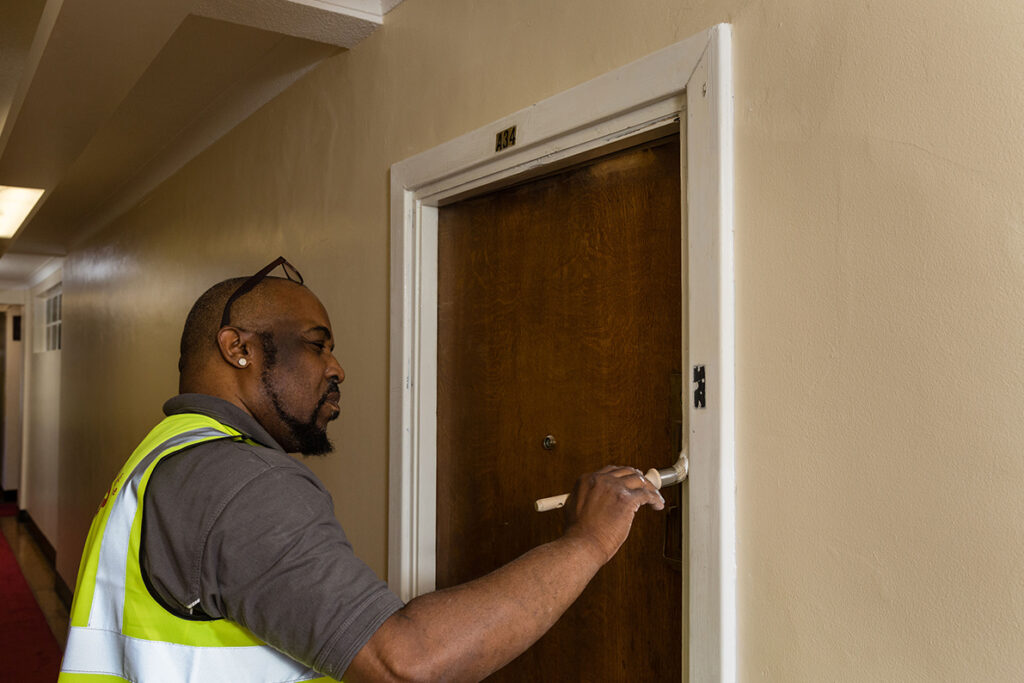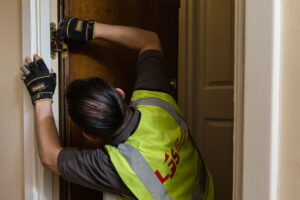
In England, the front door on any flat in a block is treated as a fire door. Fire safety laws cover them and government guidelines expect each one to have a working self-closing device. This guide explains who is responsible, what the checks involve and what to bear in mind if a front door is changed or replaced.
Flat entrance doors count as common parts of the building, so responsibility for them doesn’t just sit with the tenant.
Who Is Responsible For Flat Fire Doors?
The responsible person for the building’s common areas is accountable for them. The Fire Safety Act confirms that flat entrance doors are within the scope of the Fire Safety Order and they have to be considered in the fire risk assessment.
Tenants also have a part to play. The guidance asks them to keep fire doors shut when not in use, not to tamper with self-closing mechanisms and to report any damage to the responsible person straight away.
What Do the Fire Safety (England) Regulations 2022 Require?
Regulation 10 of the Fire Safety (England) Regulations 2022 sets out fire door checks for buildings with two or more flats. It came into force on 23rd January 2023.
The checks apply where the top storey of the building is above 11 metres. The guidance says that is typically a building of more than four storeys high. In those buildings, the responsible person must:
- Check flat entrance doors at least every 12 months
- Check fire doors in common areas at least every three months
- Make sure the checks include the self-closing devices.
Below the 11 metre threshold, the responsible person still has to put general fire precautions in place. This includes making sure flat entrance doors can provide adequate protection.
What you should check on a flat front door
- Has the original fire-resisting door been replaced with one that is not? A modern fire door should show a visible fire resistance rating
- Is the letterbox closed and not jammed open?
- Is there any visible damage to the door, the frame or the wall around it?
- If the door has fire-resisting glass, or panels beside or above it, are they in good condition?
- Are the hinges and other ironmongery secure? Look for missing or loose screws and for ventilation grilles
- If the door has intumescent strips or smoke seals, are they in good condition, in contact with the door or frame, and not painted over?
- Are the gaps around the door the right size? The guidance gives a maximum of 4mm, with the smallest practicable gap at the bottom
- Does the self-closing device work? Open the door fully and let go, then open it to about 15 degrees and let go. It should close fully both times
You don’t need a specialist for these checks. The guidance says caretakers, managing agents, housing officers and maintenance staff can do them with the right instruction.
What if a Tenant Wants to Change Their Front Door?
Changes to a front door should be made with the responsible person’s knowledge and written agreement. If a door is replaced, the guidance says the tenant should confirm that the new door is fire-resisting, that a professional installed it and that the technical information is provided.
Does Security Change Any of This?
If extra locks or security hardware are fitted to a flat front door, check them against the door’s certificate first. The British Woodworking Federation (BWF) Fire Door Alliance lists locks and latches, along with seals, hinges and closers, among the hardware that affects a door’s certification.
Talk To Us About Your Project
We manufacture FD30 and FD60 (30 and 60 minute) fire doors in-house at our Kent facility. If you are not sure what your flat entrance doors need, get in touch with us, or call 0800 035 6827.