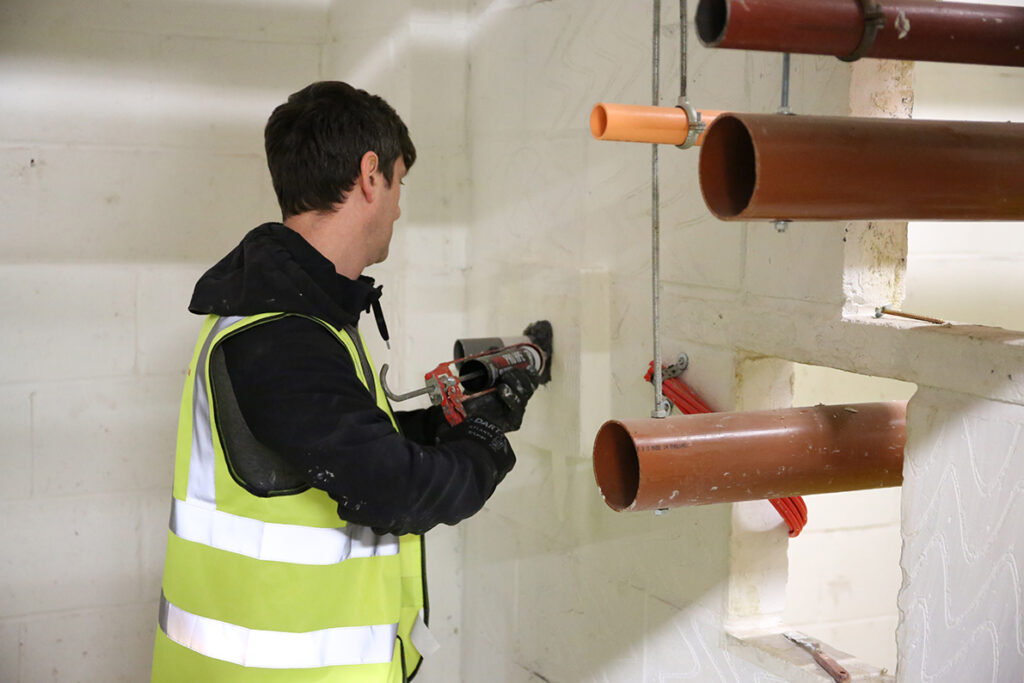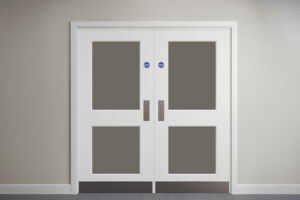
Fire stopping sits inside the walls, floors, ceiling voids and service risers within your building. It stops fire and smoke moving between rooms once a fire starts.
Enquire about a fire stopping survey
Is Fire Stopping A Legal Requirement?
Yes. Fire stopping is required under the UK’s Passive Fire Protection laws. Approved Document B of the Building Regulations sets out that a building must:
- Avoid premature collapse of a building
- Provide sufficient fire separation between and within buildings
- Include automatic fire suppression where required
- Stop fire and smoke spreading unseen through cavities
Additionally, you need to meet the Regulatory Reform (Fire Safety) Order 2005, as amended by the Fire Safety Act 2021. If you’re the ‘responsible person’ for a building, that liability sits with you. We’ve previously covered the wider rules, including the Building Safety Act, in our Grenfell: 5 Years On Guide.
What Fire Stopping Actually Covers
Fire stopping degrades over time. Pipes get replaced, cables get added, contractors drill through walls. Every one of those is a possible breach in your fire compartmentation unless it gets resealed properly.
- Fire barriers: installed within ceiling voids, roof voids or under flooring to seal off gaps between rooms, tested to official UK and European fire safety standards
- Fire curtains: lightweight and flexible, providing up to 120 minutes of fire protection in both occupied and void spaces
- Intumescent sealants: used to seal joints and gaps in partitions and firewalls, expanding under heat to give up to 4 hours of fire resistance.
- Intumescent pipe collars and wraps: PipeBloc® PWP Pipe Wrap which expands to fill gaps around pipes when heated. This helps keep exit routes clear for longer.
What Happens During Your Survey
Our fire stopping surveys give you a clear report showing which areas need improving to meet fire-stopping regulations. It also provides repair information where it’s needed. So it’s never just a generic pass or fail.
We offer two options depending on what your building needs:
- A one-off survey, for a full picture of where you stand right now.
- A three-year planned maintenance review, so you don’t have to manage it.
When You Need One
Surveys are increasingly part of a standard fire risk assessment. Insurance companies also require proof of regular fire compartmentation surveys before they’ll provide cover.
There’s no fixed time period between fire stopping surveys, but you should commission one:
- After any building work, service installation or layout changes
- If the building has complex service runs, such as multiple risers or plant rooms
- If the building has a history of poor, or no fire safety management
- If you’d like a review of its current condition
Why It Matters Now
Fire safety regulation has tightened since Grenfell. Enforcement keeps increasing. Fire and rescue services, insurers and regulators are all paying close attention to compartmentation more so now, than before. A survey now means you find out about gaps before it’s too late.
Who We Work With
We provide fire-stopping services to housing and social care providers, local authorities, public bodies, maintenance contractors and private commercial clients across London and the UK.
Why Choose LFS
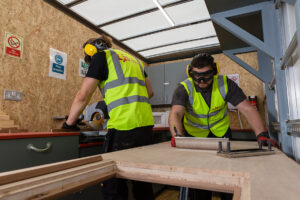
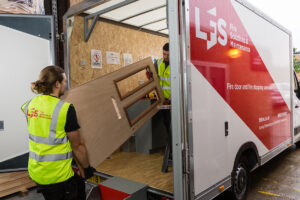
Our team is fully certified to install fire barriers, curtains, sealants and pipe collars, following test certification and manufacturer instructions. We are certified FIREFLY installers and hold accreditations from BM TRADA, FIRAS, CHAS and Safe Contractor Approved.
We are a one-stop provider. Surveying, installation, repairs, maintenance and certification is all done under one roof.
Get in touch with us to book a fire stopping survey, or call 0800 035 6827